What the animation shows
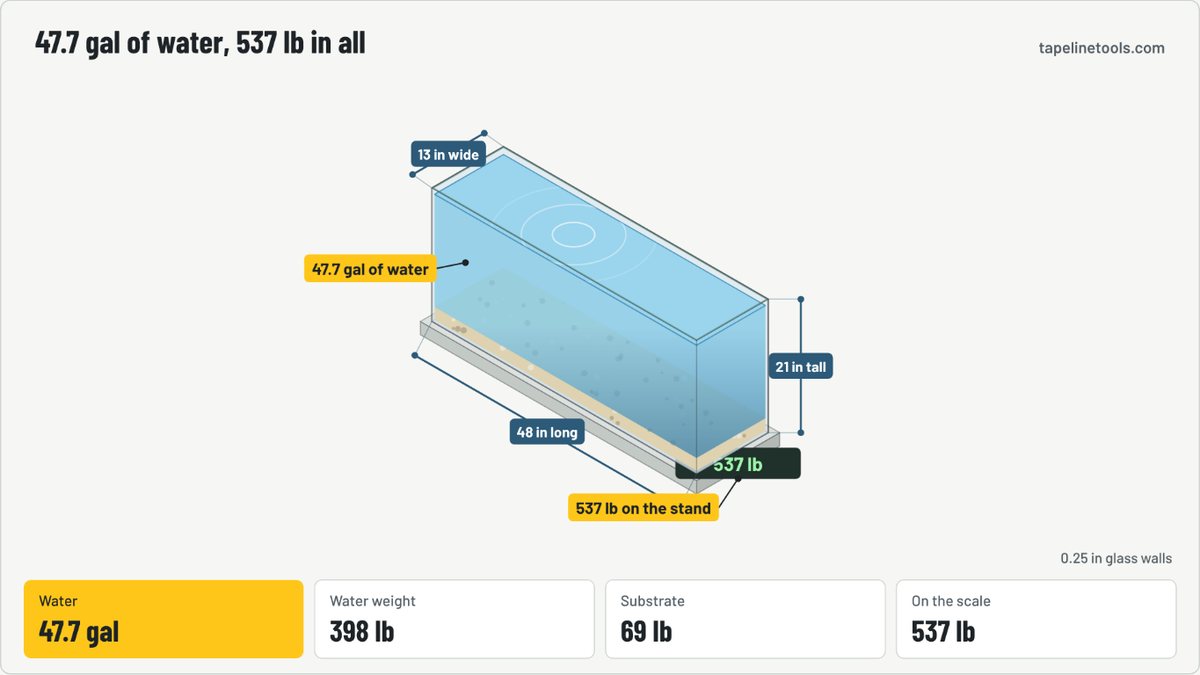
The animation and the step-by-step video above use your numbers. Here is the same walkthrough written out for the default example.
What you enter
- Tank shape: Rectangular.
- Outside length: 48 in. Rectangular tanks.
- Outside width (front to back): 13 in. Rectangular tanks.
- Outside height: 21 in. Glass only — do not include the stand or a separate lid.
- Glass or acrylic thickness: 0.25 in. Typical: 3/16–1/4 in (5–6 mm) up to 75 gal, 3/8–1/2 in (10–12 mm) for big tanks. Enter 0 for the nominal outside volume.
- Water level below the rim: 1 in.
- Substrate depth: 2 in. Gravel or sand bed depth. Enter 0 for a bare-bottom tank.
What happens, step by step
- The empty glass tank weighs about 71 lb on the scale.
- 2 in of substrate adds 69 lb; water fills its 40% gaps.
- Water fills to 1 in below the rim, inside the 0.25 in walls.
- That is 47.7 gal of real water, not the 56.7 gal label size.
- At 8.34 lb a gallon the water adds 398 lb.
- Total on the stand: about 537 lb, 124 lb per square foot.
The answer: actual water volume is 47.7 gal.
How it’s calculated
- Inside footprint: rectangle (L − 2t) × (W − 2t); cylinder π ÷ 4 × (D − 2t)²; hexagon √3 ÷ 2 × (F − 2t)², F = width across flats
- Water height = outside height − bottom glass t − gap below the rim
- Water = inside footprint × water height − substrate volume × (1 − 40% pore space)
- Gallons = cubic inches ÷ 231; water weight = gallons × 8.34 lb
- Panel weight = (outside volume − inside volume) × 156 lb/ft³ for glass or 74 lb/ft³ for acrylic; total = water + dry substrate + panels
Worked example
A standard 55 gal tank: 48 × 13 × 21 in outside, 1/4 in glass, water 1 in below the rim, 2 in of gravel.
Inputs
- Tank shape
- Rectangular
- Outside length
- 48 in
- Outside width (front to back)
- 13 in
- Outside diameter
- 24 in
- Width across flats
- 18 in
- Outside height
- 21 in
- Glass or acrylic thickness
- 0.25 in
- Tank material
- Glass
- Water level below the rim
- 1 in
- Substrate depth
- 2 in
- Substrate type
- Gravel or sand (about 100 lb/ft³)
Results
- Actual water volume
- 47.7 gal
- Nominal size (outside dimensions)
- 56.7 gal
- Estimated total filled weight
- 537 lb
- Water weight
- 398 lb
- Substrate weight (dry)
- 69 lb
- Empty tank weight (panels only)
- 71 lb
- Load over the tank’s footprint
- 124 lb/ft²
Assumptions and limits
- Open-top tank: four sides (or the round/hexagon wall) plus a bottom panel, all the same thickness. Rim trim, braces and silicone add a few pounds.
- Substrate bed is 40% water-filled pore space; dry bulk density about 100 lb/ft³ for gravel or sand and 65 lb/ft³ for aquasoil. Check the bag weight for your product.
- Fresh water at 8.34 lb/gal. Seawater is about 2.5% heavier (≈ 8.55 lb/gal).
- Hexagon is a regular hexagon (all six panels equal).
Verify the result against the applicable local code, adopted code edition, manufacturer instructions and project requirements. See our methodology.
Questions
How many gallons is a 48 × 13 × 21 inch tank really?
The outside size is 13,104 in³ = 56.7 gal. With 1/4 in glass, the water 1 in below the rim and 2 in of gravel, it actually holds about 47.7 gal of water — roughly 15% less than the label.
How much does a 55 gallon fish tank weigh when full?
About 540 lb: 398 lb of water, 69 lb of gravel and 71 lb of glass for a 48 × 13 × 21 in tank with 2 in of gravel. Rock, the stand and the lid add more.
How do you calculate gallons for a fish tank?
Multiply length × width × water height in inches and divide by 231. For a cylinder use 0.7854 × diameter² × height ÷ 231; for a hexagon use 0.866 × (width across flats)² × height ÷ 231.
How much gravel do I need for an aquarium?
Footprint × depth. A 48 × 13 in tank needs 48 × 13 × 2 = 1,248 in³ = 0.72 ft³ for a 2 in bed, about 70 lb of gravel at 100 lb/ft³ (less because the glass takes 1/4 in of each side).