What the animation shows
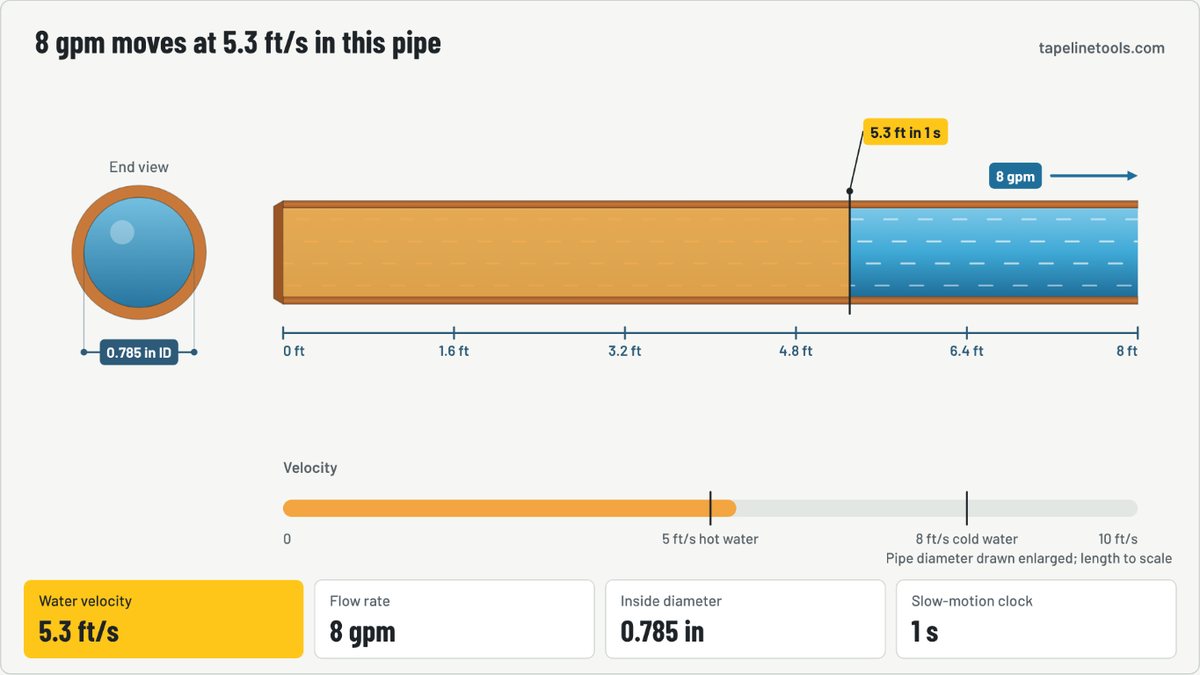
The animation and the step-by-step video above use your numbers. Here is the same walkthrough written out for the default example.
What you enter
- Calculate: Velocity from flow.
- Pipe inside diameter: 0.785 in. Use the actual inside diameter, not the nominal size. ¾ in type L copper ≈ 0.785 in.
- Flow rate: 8 gpm.
What happens, step by step
- Slow motion: orange dye tags the water entering this 0.785 in bore.
- Every half second, the dye front moves another 2.65 ft.
- 5.3 ft/s: fine for cold water, but over 5 ft/s for hot.
The answer: water velocity is 5.3 ft/s.
How it’s calculated
- Velocity (ft/s) = 0.4085 × GPM ÷ ID² (in)
- GPM = velocity × ID² ÷ 0.4085
Worked example
8 gpm through ¾ in type L copper (0.785 in ID).
Inputs
- Calculate
- Velocity from flow
- Pipe inside diameter
- 0.785 in
- Flow rate
- 8 gpm
- Velocity
- 5 ft/s
Results
- Water velocity
- 5.3 ft/s
- Flow rate
- 8 gpm
Assumptions and limits
- Full pipe, incompressible water flow.
Verify the result against the applicable local code, adopted code edition, manufacturer instructions and project requirements. See our methodology.
Questions
What is a good water velocity in pipes?
Common guidance is up to about 8 ft/s for cold water and 5 ft/s for hot water in copper to limit noise and erosion. Manufacturer and code limits vary.
How much water can a ¾ inch pipe carry?
At 8 ft/s, ¾ in type L copper (0.785 in ID) carries about 12 gpm; at 5 ft/s, about 7.5 gpm.