What the animation shows
The animation and the step-by-step video above use your numbers. Here is the same walkthrough written out for the default example.
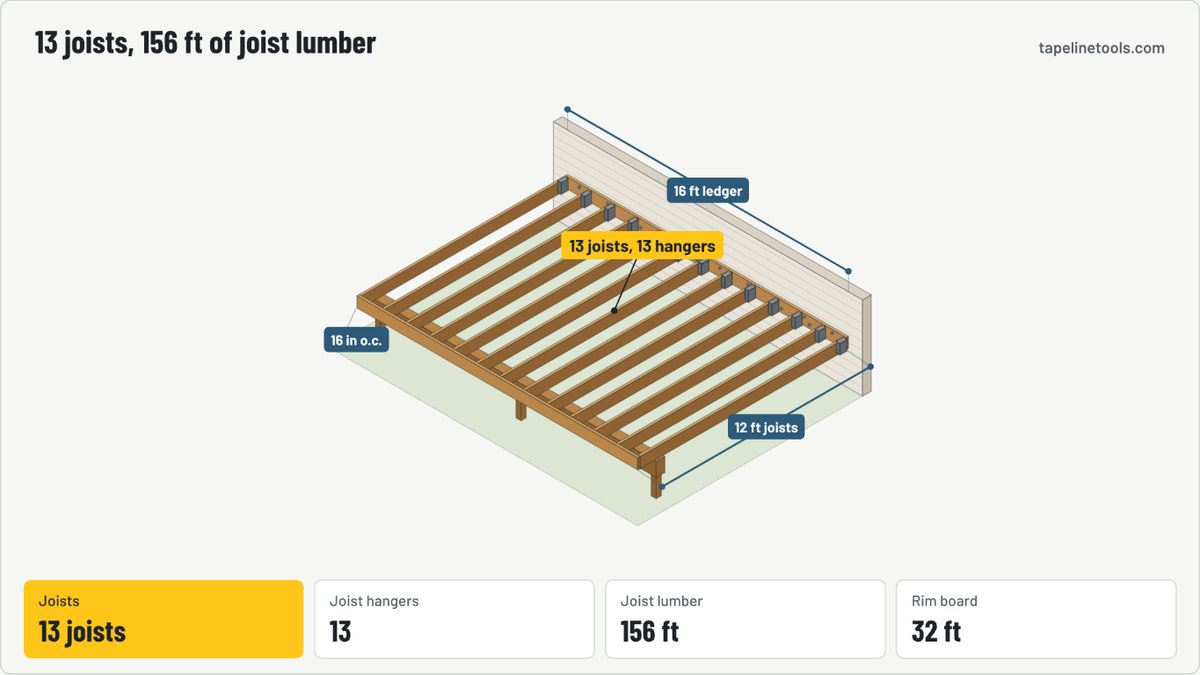
What you enter
- Deck length along the ledger/beam: 16 ft.
- Joist length: 12 ft.
- Joist spacing (on center): 16 in.
What happens, step by step
- Joists drop onto the ledger, one every 16 in on center.
- Each joist hangs from the ledger in a metal hanger.
- 16 ft ÷ 16 in, rounded up, plus one for the end: 13 joists.
- A rim board caps the ends. Joist lumber: 156 ft.
The answer: joists is 13 joists.
How it’s calculated
- Joists = ledger length ÷ spacing, rounded up, + 1
- Linear length = joists × joist length
- Rim board = 2 × ledger length (end rim at the outer edge plus a band along the ledger side, if used)
Worked example
16 ft ledger, 12 ft joists at 16 in on center.
Inputs
- Deck length along the ledger/beam
- 16 ft
- Joist length
- 12 ft
- Joist spacing (on center)
- 16 in
- Price per joist
- 0 $
Results
- Joists
- 13 joists
- Joist hangers (at ledger)
- 13
- Joist linear length
- 156 ft
- Rim board length (both ends)
- 32 ft
Assumptions and limits
- Joists run perpendicular to the ledger at uniform spacing.
- Extra joists for stairs, doubled joists at board seams and blocking are not included.
- Joist size and span are NOT checked.
Verify the result against the applicable local code, adopted code edition, manufacturer instructions and project requirements. See our methodology.
Questions
How many joists for a 16 ft deck at 16 in on center?
16 ft is 192 in; 192 ÷ 16 = 12 spaces, so 13 joists including both ends.
What size joists do I need?
Joist size depends on span, spacing, lumber species and grade, and design load. Use the span tables in your adopted code or the lumber manufacturer, or ask your building department.