What the animation shows
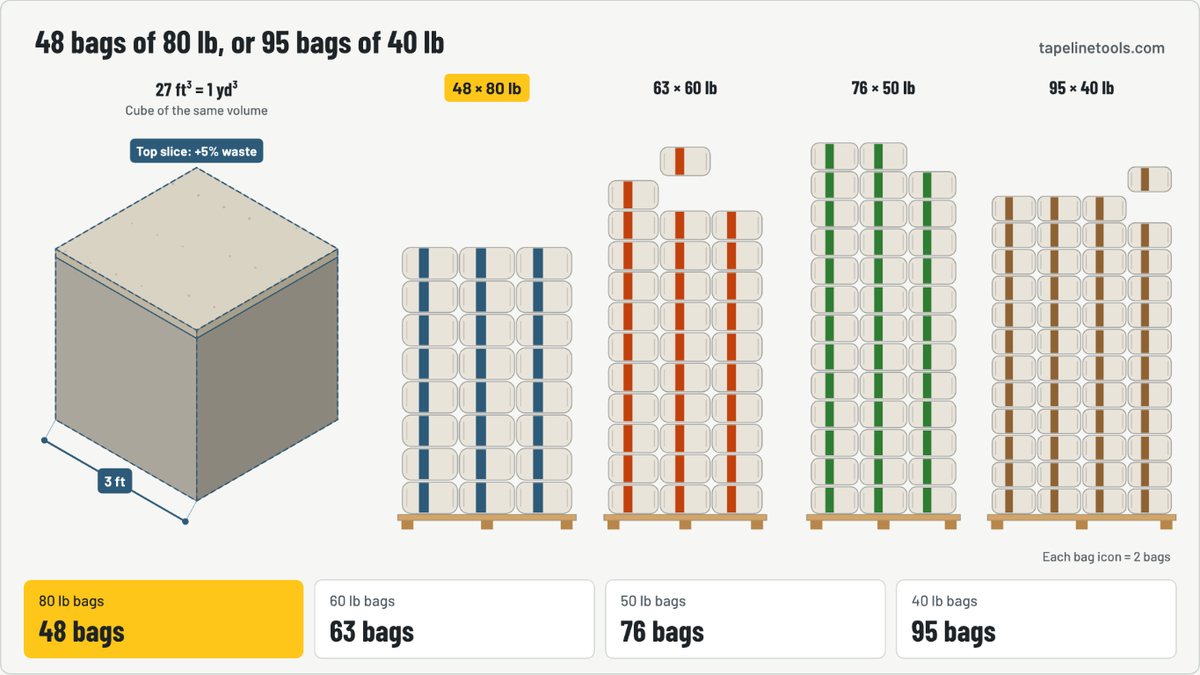
The animation and the step-by-step video above use your numbers. Here is the same walkthrough written out for the default example.
What you enter
- Concrete volume: 1 cu yd.
- Extra for waste: 5 %.
What happens, step by step
- The cube fills to your 27 ft³ while each pallet stacks bags.
- Smaller bags make less concrete each, so their stacks grow bigger.
- Each count is the volume ÷ one bag's yield, rounded up.
- The top slice is the 5% extra for spills and uneven ground.
The answer: 80 lb bags is 48 bags.
How it’s calculated
- Bags = volume (ft³) × (1 + waste %) ÷ bag yield (ft³), rounded up
Worked example
1 cubic yard of concrete with 5% waste.
Inputs
- Concrete volume
- 1 cu yd
- Extra for waste
- 5 %
- Price per 80 lb bag
- 0 $
- Price per 60 lb bag
- 0 $
Results
- 80 lb bags
- 48 bags
- 60 lb bags
- 63 bags
- 50 lb bags
- 76 bags
- 40 lb bags
- 95 bags
Assumptions and limits
- Bag counts use typical manufacturer yields for pre-mixed concrete. Check the yield printed on your bag.
Verify the result against the applicable local code, adopted code edition, manufacturer instructions and project requirements. See our methodology.
Questions
How many 80 lb bags make a cubic yard?
At about 0.60 ft³ per bag, one cubic yard (27 ft³) needs 45 bags of 80 lb mix before any waste allowance.
When should I order ready-mix instead?
Beyond roughly one cubic yard, mixing 45+ bags by hand becomes slow and risks cold joints. Ready-mix or a short-load delivery is usually better.