What the animation shows
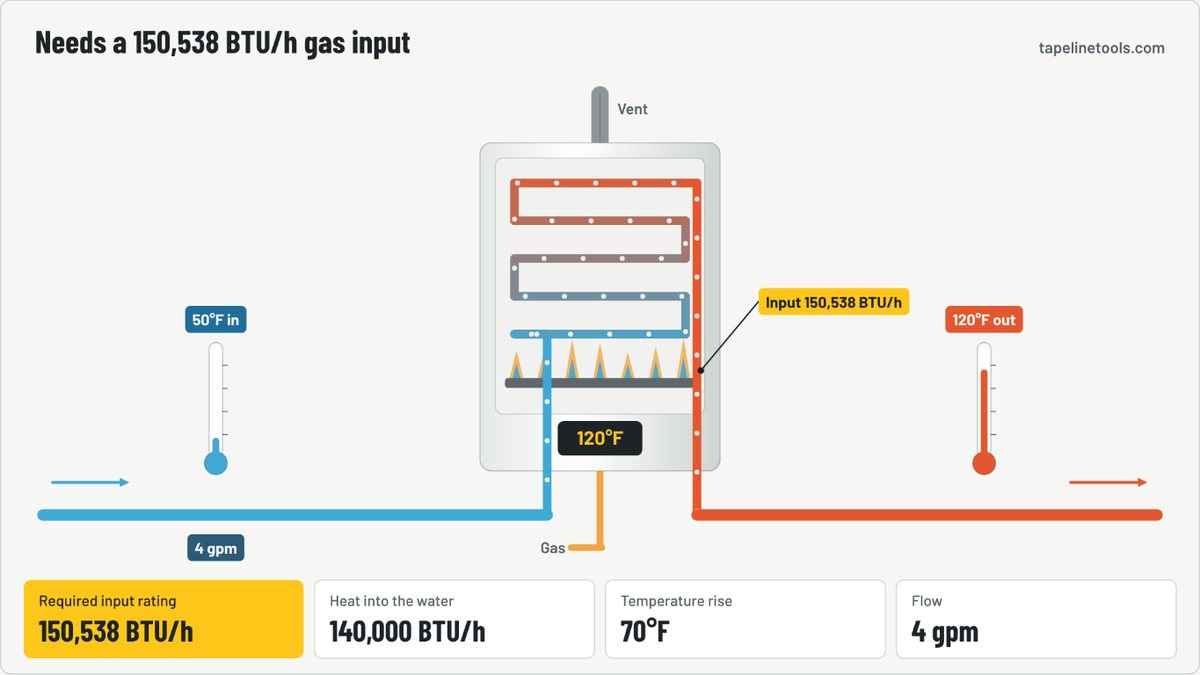
The animation and the step-by-step video above use your numbers. Here is the same walkthrough written out for the default example.
What you enter
- Flow rate: 4 gpm.
- Coldest incoming water temperature: 50 °F.
- Desired outlet temperature: 120 °F.
- Fuel: Gas.
- Heater efficiency: 93 %.
What happens, step by step
- Flow lights the burner; 4 gpm heats as it crosses the coil.
- Raising 4 gpm by 70°F takes 140,000 BTU/h of heat.
- At 93% efficiency the burner needs 150,538 BTU/h of gas input.
- Colder inlet water means a bigger rise and a bigger heater.
The answer: required input rating is 150,538 BTU/h.
How it’s calculated
- Output (BTU/h) = 500 × GPM × temperature rise
- 500 ≈ 8.33 lb/gal × 60 min/h × 1 BTU/lb·°F
- Input = output ÷ efficiency; amps = watts ÷ volts
Worked example
4 gpm with 50 °F inlet and 120 °F outlet, gas at 93% efficiency.
Inputs
- Flow rate
- 4 gpm
- Coldest incoming water temperature
- 50 °F
- Desired outlet temperature
- 120 °F
- Fuel
- Gas
- Heater efficiency
- 93 %
- Supply voltage (electric)
- 240 V
Results
- Required input rating
- 150,538 BTU/h
- Heat delivered to water
- 140,000 BTU/h
- Temperature rise
- 70 °F
Assumptions and limits
- Efficiency is steady-state; use the manufacturer’s flow-vs-rise chart to confirm a model.
Verify the result against the applicable local code, adopted code edition, manufacturer instructions and project requirements. See our methodology.
Questions
What size tankless water heater do I need?
Two showers (about 2 gpm each) with a 70 °F rise need about 140,000 BTU/h delivered, roughly 150,000 BTU/h input for a 93% gas unit.
Why does winter matter?
Colder inlet water means a larger temperature rise, so the same heater delivers fewer gallons per minute.