What the animation shows
The animation and the step-by-step video above use your numbers. Here is the same walkthrough written out for the default example.
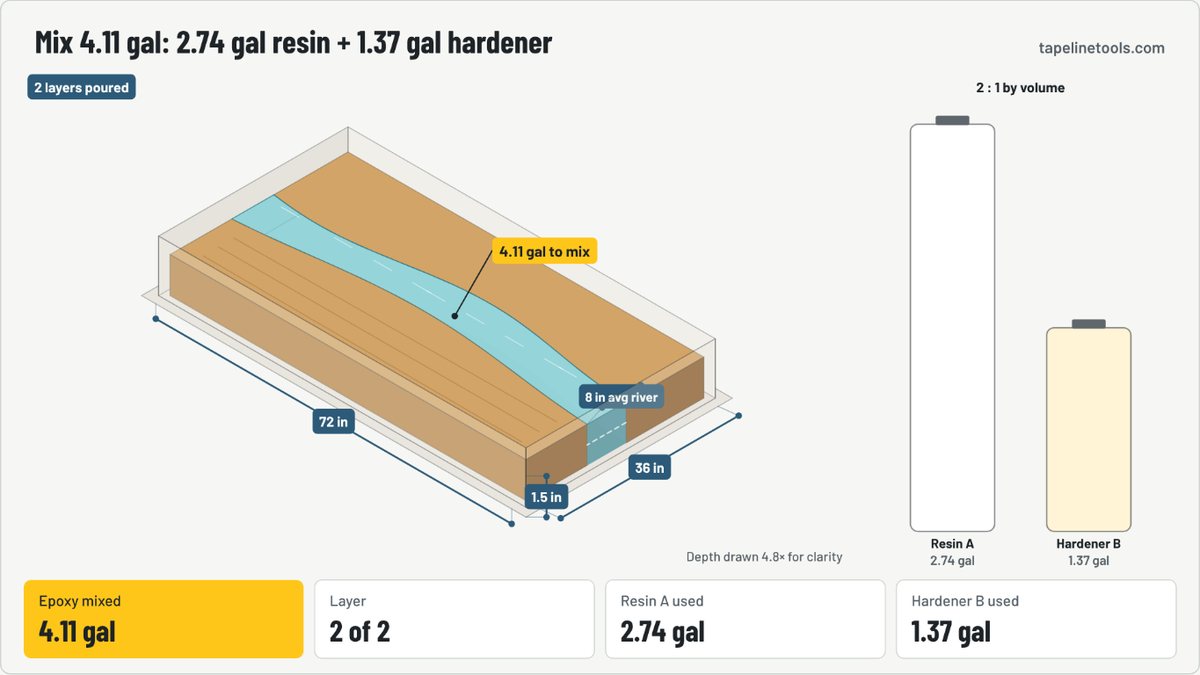
What you enter
- Pour shape: River table (resin channel between slabs).
- Length: 72 in. Length of the table, mold, river or floor.
- Average river width (river tables): 8 in. Measure the gap between the slabs at several points along its length and average them.
- Pour depth (thickness): 1.5 in. River tables are usually 1–2 in thick. Table-top flood coats are about 1/8 in (0.125). Floor coatings are 10–20 mils (0.010–0.020 in).
- Maximum pour depth per layer: 1 in. From the resin’s technical data sheet. Table-top and coating epoxies: about 1/8–1/4 in. Deep-pour casting resins: about 1–2 in, some up to 4 in.
- Mix ratio, resin : hardener (by volume): 2 : 1. Use the ratio printed on your kit. If the kit is mixed by weight, use the manufacturer’s weight ratio instead.
- Extra for leaks, cup residue and sanding: 10 %. Common allowance is 10–15%. Live-edge slabs soak up resin and leak through gaps; seal them first.
What happens, step by step
- This form holds 3.74 gal of resin, plus 10% extra for losses.
- Your resin takes 1 in per pour, so each layer is 0.75 in.
- The layer must cure before the next pour, or it can overheat.
- The jugs drain 2 parts resin to 1 part hardener, by volume.
- Mix 4.11 gal in all: 2.74 gal resin and 1.37 gal hardener.
The answer: epoxy to mix (with extra) is 4.11 gal.
How it’s calculated
- Area: rectangle or floor = length × width; river = length × average river width; circle = π ÷ 4 × diameter²
- Net volume = area × depth (1 US gallon = 231 cubic inches)
- Epoxy to mix = net volume × (1 + extra %)
- Resin = total × A ÷ (A + B); hardener = total × B ÷ (A + B) (2 : 1 → two-thirds resin, one-third hardener)
- Layers = depth ÷ maximum pour depth, rounded up; each layer = depth ÷ layers
Worked example
A 72 in long river table with an 8 in average river, 1.5 in thick, using a 2:1 deep-pour resin rated to 1 in per layer, with 10% extra.
Inputs
- Pour shape
- River table (resin channel between slabs)
- Length
- 72 in
- Width
- 36 in
- Average river width (river tables)
- 8 in
- Diameter (circle)
- 24 in
- Pour depth (thickness)
- 1.5 in
- Maximum pour depth per layer
- 1 in
- Mix ratio, resin : hardener (by volume)
- 2 : 1
- Extra for leaks, cup residue and sanding
- 10 %
- Mixed epoxy price per gallon
- 0 $/gal
Results
- Epoxy to mix (with extra)
- 4.11 gal
- In fluid ounces
- 527 fl oz
- Resin (part A)
- 2.74 gal
- Hardener (part B)
- 1.37 gal
- Pours (layers) needed
- 2 layers
- Thickness of each layer
- 0.75 in
- Net volume of the pour
- 3.74 gal
Assumptions and limits
- The pour is a flat, even depth. Live-edge voids, knots and bark inclusions add volume; that is what the extra percentage covers.
- Mix ratio is by volume. Many kits list a different ratio by weight because resin and hardener densities differ.
- Maximum pour depth and recoat time vary by product and room temperature; follow your resin’s technical data sheet.
- Floor coating volume ignores absorption into bare concrete. A primer coat on porous concrete can use 20–50% more.
Verify the result against the applicable local code, adopted code edition, manufacturer instructions and project requirements. See our methodology.
Questions
How much epoxy do I need for a river table?
Multiply length × average river width × thickness in inches and divide by 231 for gallons. A 72 × 8 in river 1.5 in deep is 864 in³ = 3.74 gal, or about 4.1 gal with 10% extra.
How much epoxy for a table top coat?
A 1/8 in flood coat on a 48 × 24 in top is 48 × 24 × 0.125 = 144 in³, which is 0.62 gal or about 80 fl oz before extra for drips over the edge.
How do I split resin and hardener at 2:1?
Two-thirds of the total is resin and one-third is hardener. For 3 gallons mixed, use 2 gallons of resin and 1 gallon of hardener, measured by volume unless the kit says by weight.
How much epoxy does a garage floor take?
At 10 mils (0.010 in), a 20 × 20 ft floor needs 400 × 144 × 0.010 = 576 in³ = 2.5 gal per coat, before primer absorption and waste.