What the animation shows
The animation and the step-by-step video above use your numbers. Here is the same walkthrough written out for the default example.
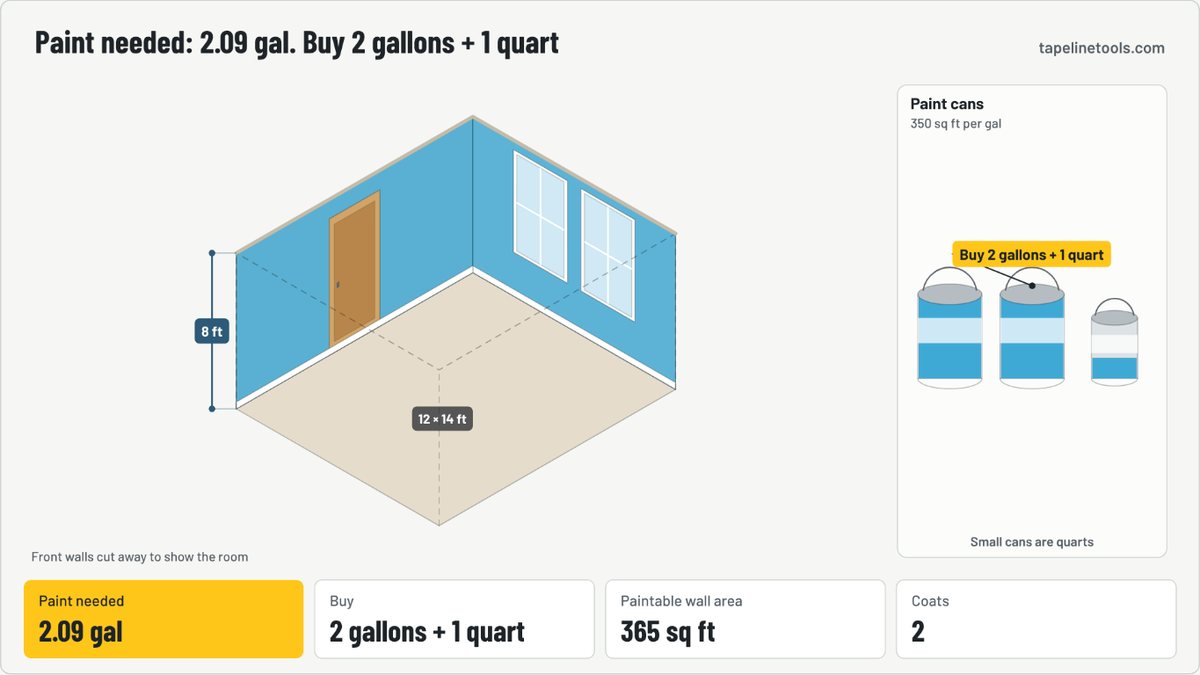
What you enter
- Rooms: 12 × 14 ft.
- Wall height: 8 ft.
- Doors (total, all rooms): 1. Each door is taken as 21 sq ft (3 × 7 ft).
- Windows (total): 2. Each window is taken as 15 sq ft (3 × 5 ft).
- Coats: 2.
- Coverage per gallon: 350 sq ft. Most interior paints list 250–400 sq ft per gallon. Rough or porous surfaces get less.
- Paint the ceilings too: No.
What happens, step by step
- Coat 1 covers 365 sq ft of walls at 350 sq ft per gallon.
- Doors and windows stay bare, so their area is subtracted.
- Coat 2 covers the same area again, so the paint doubles.
- 2.09 gal in all, so buy 2 gallons + 1 quart.
The answer: paint needed is 2.09 gal.
How it’s calculated
- Wall area = Σ 2 × (length + width) × height − doors × 21 − windows × 15
- Gallons = (wall area + ceiling area) × coats ÷ coverage
- Primer (one coat) = area ÷ coverage
Worked example
One 12 × 14 ft room, 8 ft walls, 1 door, 2 windows, 2 coats at 350 sq ft/gal.
Inputs
- Rooms
- 12 × 14 ft
- Wall height
- 8 ft
- Doors (total, all rooms)
- 1
- Windows (total)
- 2
- Coats
- 2
- Coverage per gallon
- 350 sq ft
- Paint the ceilings too
- No
- Add one coat of primer
- No
- Price per gallon
- 0 $
Results
- Paint needed
- 2.09 gal
- Buy
- 2 gallons + 1 quart
- Paintable wall area
- 365 sq ft
Assumptions and limits
- Doors are 21 sq ft and windows 15 sq ft each.
- Trim, closets and textured surfaces are not included.
- Primer uses the same coverage rate as the paint; check the primer label.
Verify the result against the applicable local code, adopted code edition, manufacturer instructions and project requirements. See our methodology.
Questions
How many gallons of paint for a 12×14 room?
With 8 ft walls, one door and two windows, the walls are about 365 sq ft. Two coats at 350 sq ft per gallon need about 2.1 gallons — buy 2 gallons and 1 quart.
Do I need primer?
Prime new drywall, bare wood, stains, glossy surfaces, and large color changes. Painting over sound paint of a similar color often needs no primer.