What the animation shows
The animation and the step-by-step video above use your numbers. Here is the same walkthrough written out for the default example.
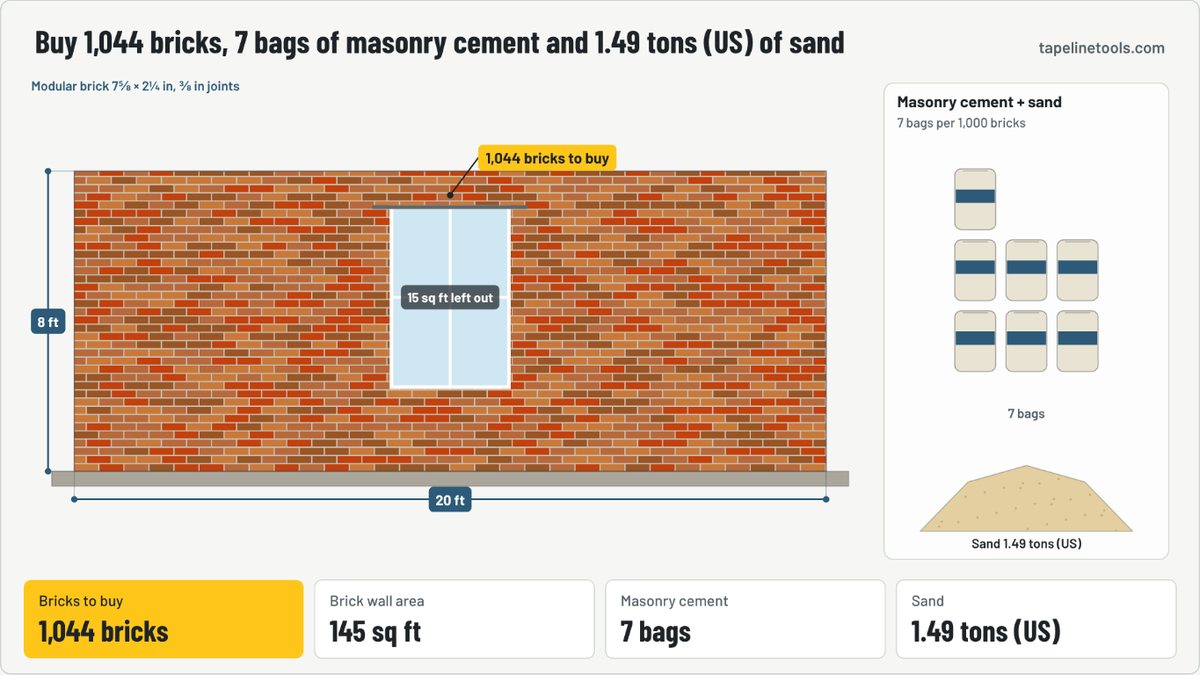
What you enter
- Wall length: 20 ft.
- Wall height: 8 ft.
- Openings to leave out (doors, windows): 15 sq ft. Total area of openings. A 3 × 5 ft window is 15 sq ft; a 3 × 6⅔ ft door is 20 sq ft.
- Brick size: Modular – 7⅝ × 2¼ × 3⅝ in. Actual sizes vary slightly by manufacturer. Modular is the most common US face brick.
- Mortar joint: 0.375 in. ⅜ in is standard for brick; ½ in joints use fewer bricks and more mortar.
- Extra for breakage and cuts: 5 %. The Brick Industry Association recommends at least 5%. Use 10% with many cuts or openings.
- Wall thickness: Single wythe (veneer).
What happens, step by step
- Courses go up in running bond, each one offset by half a brick.
- The openings are skipped: their area comes off the wall.
- With ⅜ in joints, each square foot takes 6.86 modular bricks.
- Mortar runs about 7 bags of masonry cement per 1,000 bricks.
- Plus 5% for breakage: 1,044 bricks, 7 bags of cement, 1.49 tons (US) of sand.
The answer: bricks to buy is 1,044 bricks.
How it’s calculated
- Wall area = length × height − openings
- Bricks per sq ft = 144 ÷ ((brick length + joint) × (brick height + joint)), in inches
- Bricks = wall area × bricks per sq ft × wythes × (1 + waste %), rounded up
- Masonry cement bags = bricks laid ÷ 1,000 × bags per 1,000 (scaled by joint face area when left at 0)
- Sand = 1½ tons per 7 bags of masonry cement
- Premixed mortar bags = bricks laid × (rate ÷ 7) ÷ bricks per bag
Worked example
A 20 × 8 ft modular brick veneer wall with one 3 × 5 ft window, ⅜ in joints and 5% waste.
Inputs
- Wall length
- 20 ft
- Wall height
- 8 ft
- Openings to leave out (doors, windows)
- 15 sq ft
- Brick size
- Modular – 7⅝ × 2¼ × 3⅝ in
- Mortar joint
- 0.375 in
- Wall thickness
- Single wythe (veneer)
- Extra for breakage and cuts
- 5 %
- Masonry cement bags per 1,000 bricks
- 0
- Bricks per 80 lb bag of mortar mix
- 37
Results
- Bricks to buy
- 1,044 bricks
- Brick wall area (minus openings)
- 145 sq ft
- Bricks per square foot
- 6.86 per sq ft
- Masonry cement
- 7 bags
- Masonry sand to mix with it
- 1.49 tons (US)
- Or premixed 80 lb mortar mix
- 27 bags
- Mortar rate used
- 7 bags per 1,000 bricks
Assumptions and limits
- Running bond with full head and bed joints. Brick sizes are specified (actual) dimensions from BIA Technical Note 10.
- Typical masonry cement figures with ⅜ in joints follow a brick maker’s rule of thumb (General Shale): modular 7, queen 6.5, king 9 bags per 1,000 bricks, with 1½ tons of sand per 7 bags. Standard brick is taken as modular (its joint volume is within 4%).
- Mortar is based on bricks actually laid (before brick waste). The premixed-mortar alternative scales the per-bag brick count by the same rate ÷ 7.
- Double-wythe walls double bricks and face mortar; the collar joint between layers is not included.
Sources: Brick Industry Association, Technical Note 10: Dimensioning and Estimating Brick Masonry General Shale (Canada Brick) Technical Bulletin: Rule of Thumb Figures QUIKRETE Mortar Mix (No. 1102) data sheet
Verify the result against the applicable local code, adopted code edition, manufacturer instructions and project requirements. See our methodology.
Questions
How many bricks per square foot?
With ⅜ in joints: modular brick 6.86, standard 6.55, queen 5.76 and king 4.61 per square foot of wall face, before waste.
How many bricks do I need for a 20 × 8 ft wall?
A 20 × 8 ft wall is 160 sq ft. In modular brick that is 1,098 bricks with no openings, or about 1,152 with 5% extra for breakage.
How much mortar for 1,000 bricks?
About 7 bags of masonry cement and 1½ tons of sand for 1,000 modular bricks with ⅜ in joints. With premixed 80 lb mortar mix, plan on roughly 27 bags (37 bricks per bag).
How much extra brick should I order?
At least 5% for breakage and cuts, more for walls with many openings or corners. Order all brick at once so the color blend matches.