What the animation shows
The animation and the step-by-step video above use your numbers. Here is the same walkthrough written out for the default example.
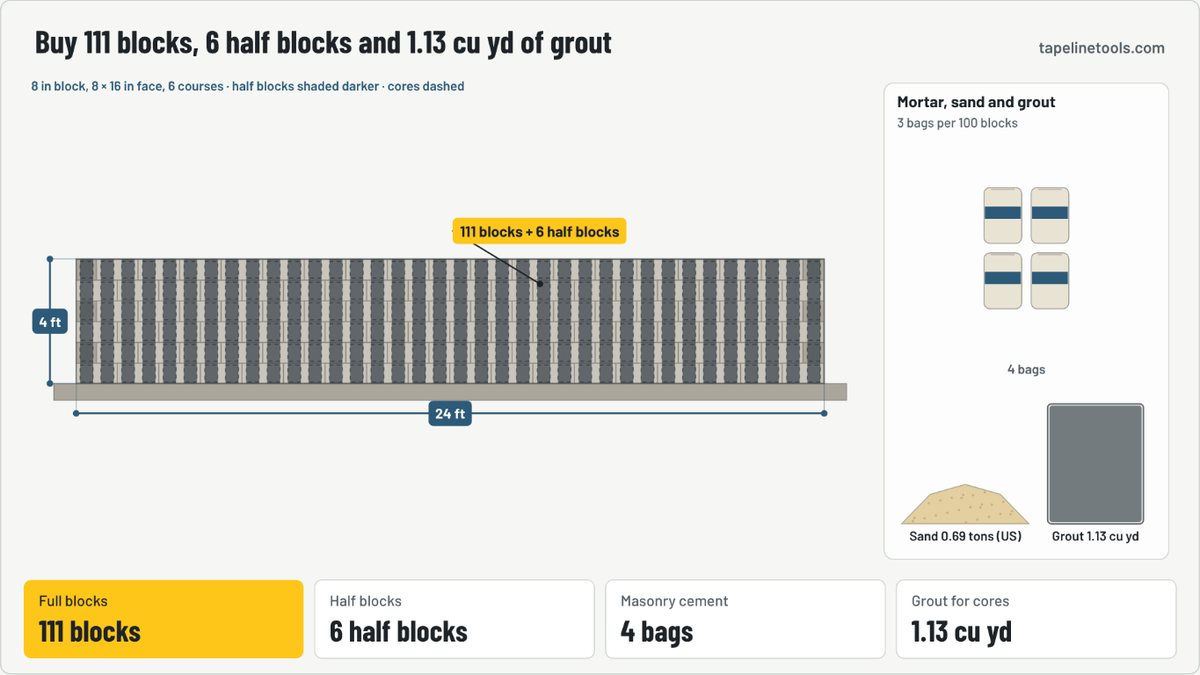
What you enter
- Wall length: 24 ft.
- Wall height: 4 ft. Block courses are 8 in tall: 4 ft = 6 courses, 8 ft = 12 courses.
- Openings to leave out (doors, windows): 0 sq ft.
- Block width: 8 in (7⅝ in actual) – standard 8×8×16.
- Fill cores with grout: Yes. Reinforced walls are grouted in the cells that hold rebar, or solid. Follow your plans or local code.
- Share of cores filled: 100 %. 100% = solid grouted. Cells sit every 8 in, so grouting cells with rebar every 16 in fills about half, every 32 in about a quarter.
- Extra for breakage and cuts: 5 %. Applied to blocks and grout. 5% is typical; more for walls with many openings.
What happens, step by step
- Every square foot of wall takes 1.125 blocks with an 8 × 16 in face.
- Every other course starts and ends with a half block.
- Mortar runs about 3 bags of masonry cement per 100 blocks.
- Grout fills every core, top to bottom.
- That takes 1.13 cu yd of grout, with 5% extra.
The answer: full blocks to buy is 111 blocks.
How it’s calculated
- Wall area = length × height − openings
- Block equivalents = wall area × 1.125 (one 8 × 16 in face = 0.889 sq ft)
- Courses = height ÷ 8 in, rounded up; half blocks = 2 per alternate course
- Full blocks = block equivalents × (1 + waste %) − half blocks ÷ 2, rounded up
- Masonry cement bags = block equivalents ÷ 100 × bags per 100; sand = 1½ tons per 7 bags
- Grout (yd³) = block equivalents × share filled ÷ blocks per yd³ (6 in: 120, 8 in: 100, 12 in: 65) × (1 + waste %)
Worked example
A 24 ft long, 4 ft high wall of 8 in block, solid grouted, 5% waste.
Inputs
- Wall length
- 24 ft
- Wall height
- 4 ft
- Openings to leave out (doors, windows)
- 0 sq ft
- Block width
- 8 in (7⅝ in actual) – standard 8×8×16
- Extra for breakage and cuts
- 5 %
- Fill cores with grout
- Yes
- Share of cores filled
- 100 %
- Masonry cement bags per 100 blocks
- 3
- Blocks per 80 lb bag of mortar mix
- 13
Results
- Full blocks to buy
- 111 blocks
- Half blocks (wall ends)
- 6 half blocks
- Courses (8 in high)
- 6 courses
- Block wall area (minus openings)
- 96 sq ft
- Masonry cement
- 4 bags
- Masonry sand to mix with it
- 0.69 tons (US)
- Or premixed 80 lb mortar mix
- 9 bags
- Grout for cores
- 1.13 cu yd
Assumptions and limits
- Standard 8 × 16 in face units with ⅜ in joints laid in running bond on a straight wall with two free ends.
- Mortar uses face-shell bedding; the same bag rate is used for 6, 8 and 12 in units.
- Grout fill rates are common rules of thumb for two-core hollow units; actual core volume varies by block design and absorption.
- Corner, bond-beam, lintel and pilaster units are not counted separately.
Sources: General Shale (Canada Brick) Technical Bulletin: Rule of Thumb Figures (1.125 blocks per sq ft, 3 bags per 100 blocks) QUIKRETE Mortar Mix (No. 1102) data sheet ASTM C476 — Standard Specification for Grout for Masonry
Verify the result against the applicable local code, adopted code edition, manufacturer instructions and project requirements. See our methodology.
Questions
How many concrete blocks per square foot?
1.125 blocks per square foot for standard 8 × 16 in face block, or 112.5 blocks per 100 sq ft, before waste. Width (6, 8 or 12 in) does not change the count.
How many blocks for a 24 ft long, 4 ft high wall?
24 × 4 = 96 sq ft × 1.125 = 108 block equivalents in 6 courses of 18. In running bond that is about 105 full blocks plus 6 half blocks, before waste.
How much grout to fill concrete block?
Roughly 1 cubic yard fills the cores of 100 standard 8 in blocks (about 89 sq ft of solid-grouted wall). 6 in blocks take about 120 per yard and 12 in blocks about 65.
How much mortar for 100 blocks?
About 3 bags of masonry cement plus about 0.65 tons of sand, or around 8 bags of 80 lb premixed mortar mix at 13 blocks per bag.