What the animation shows
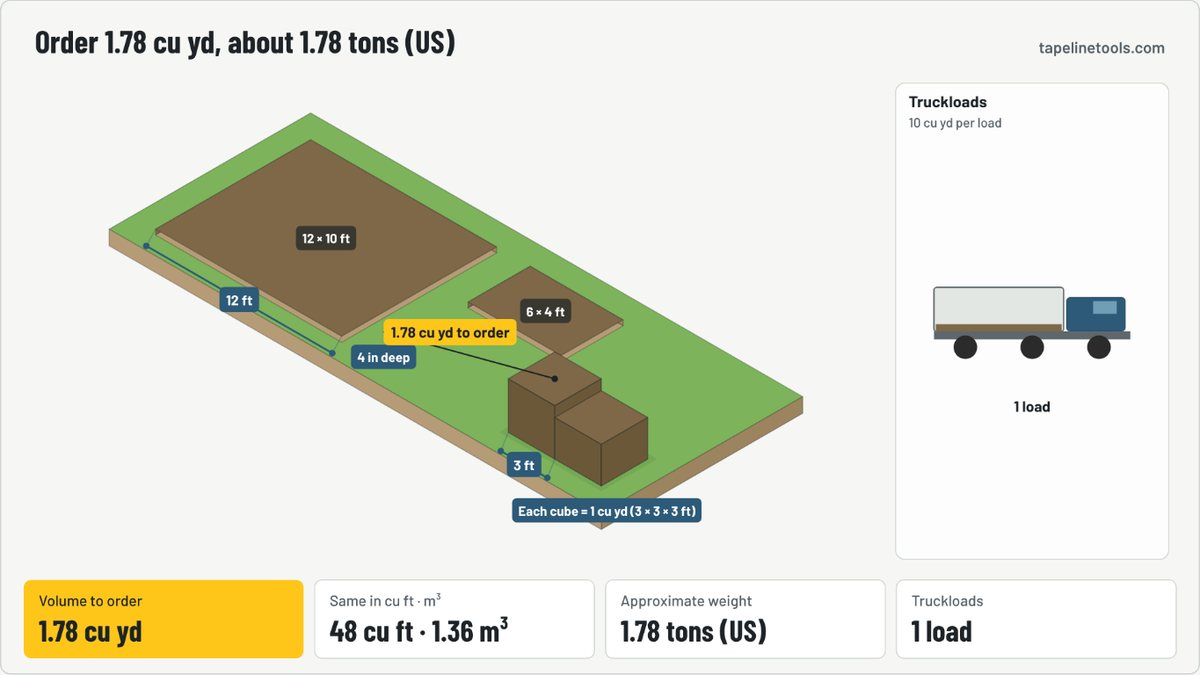
The animation and the step-by-step video above use your numbers. Here is the same walkthrough written out for the default example.
What you enter
- Areas (length × width): 12 × 10; 6 × 4 ft.
- Depth: 4 in. Typical: mulch 2–3 in, topsoil for lawns 4–6 in, gravel paths 3–4 in, driveway base 6–8 in.
- Material (for weight): Topsoil (≈2,000 lb/yd³). Densities are typical loose, as-delivered values. Wet material can weigh 20–30% more. Your supplier’s figure is best.
- Extra for settling or compaction: 0 %. Loose soil and gravel settle. Add 10–20% if it will be compacted; 0% for a straight volume.
- Truck capacity per load: 10 cu yd. Single-axle dump trucks carry roughly 5–10 cu yd and tandems 10–16 cu yd. A half-ton pickup is usually weight-limited to about 1 cu yd of soil or gravel.
What happens, step by step
- Each area is dug 4 in deep: area times depth is the volume.
- 144 sq ft × 4 in = 48 cu ft, divided by 27 for yards.
- One cubic yard is a 3 ft cube: this job is 1.78 cu yd.
- About 1.78 tons (US): 1 load at 10 cu yd per truck.
The answer: volume to order is 1.78 cu yd.
How it’s calculated
- Area = Σ length × width
- Cubic feet = area × depth (ft)
- Cubic yards = cubic feet ÷ 27; cubic meters = cubic feet × 0.02832
- Order = volume × (1 + extra %)
- Weight (lb) = cubic yards × density (lb per cubic yard); tons = lb ÷ 2,000
- Truckloads = order ÷ truck capacity, rounded up
Worked example
A 12 × 10 ft garden bed and a 6 × 4 ft strip, 4 in of topsoil.
Inputs
- Areas (length × width)
- 12 × 10; 6 × 4 ft
- Depth
- 4 in
- Material (for weight)
- Topsoil (≈2,000 lb/yd³)
- Custom density (only for Custom)
- 2200 lb/yd³
- Extra for settling or compaction
- 0 %
- Truck capacity per load
- 10 cu yd
- Price per cubic yard (optional)
- 0 $/yd³
Results
- Volume to order
- 1.78 cu yd
- Net volume (no extra)
- 1.78 cu yd
- Total area
- 144 sq ft
- Approximate weight
- 1.78 tons (US)
- Truckloads
- 1 load
Assumptions and limits
- Each area is a rectangle with a uniform depth.
- Tons are US short tons (2,000 lb).
- Material densities are typical loose values; moisture and product change them.
- Truck capacity is by volume only. Heavy material may hit the truck’s weight limit first.
Verify the result against the applicable local code, adopted code edition, manufacturer instructions and project requirements. See our methodology.
Questions
How many cubic yards do I need for a 10 × 10 area 4 inches deep?
10 × 10 ft × 0.333 ft = 33.3 cubic feet, which is 1.23 cubic yards. Round up to 1.25 or 1.5 yards when ordering bulk.
How much does a cubic yard weigh?
It depends on the material: mulch is about 400–800 lb, dry topsoil about 2,000 lb, gravel and sand about 2,400–2,900 lb, and fresh concrete about 4,000 lb.
How many square feet does a cubic yard cover?
One cubic yard covers 324 sq ft at 1 in deep, 162 sq ft at 2 in, 108 sq ft at 3 in, 81 sq ft at 4 in and 54 sq ft at 6 in.
How many cubic yards fit in a pickup truck?
A full-size bed holds about 2 cubic yards by volume, but most half-ton pickups reach their payload at about 1 cubic yard of soil, sand or gravel. Check the payload rating on the door sticker.