What the animation shows
The animation and the step-by-step video above use your numbers. Here is the same walkthrough written out for the default example.
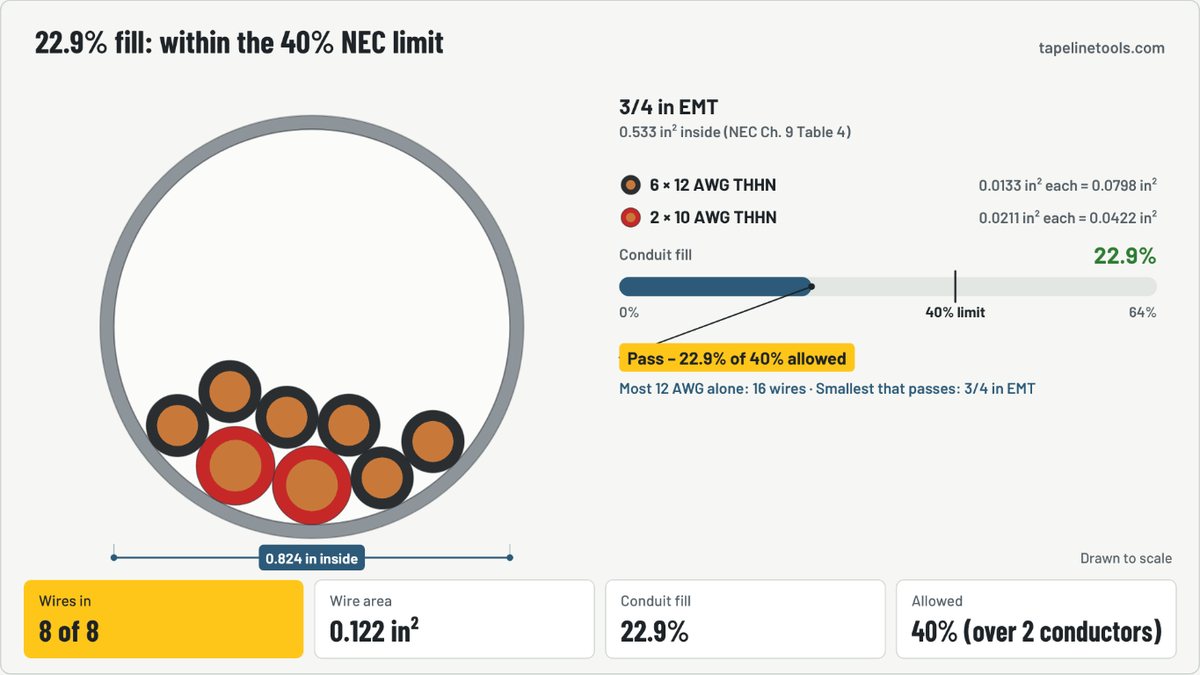
What you enter
- Conduit type: EMT (electrical metallic tubing).
- Trade size: 3/4 in. EMT and FMC are listed up to 4 in; PVC and RMC up to 6 in.
- Wire group 1: size: 12 AWG.
- Wire group 1: number of wires: 6.
- Wire group 2: size: 10 AWG.
- Wire group 2: number of wires: 2.
- Conduit nipple 24 in long or shorter: No. NEC Chapter 9 Note 4 allows 60% fill in a nipple of 24 in or less between boxes or enclosures.
What happens, step by step
- 3/4 in EMT has 0.533 in² of space inside.
- Each 12 AWG THHN wire takes 0.0133 square inches, insulation included.
- All 8 wires add up to 0.122 in², 22.9% of the conduit.
- The NEC allows 40% for this many wires, so it passes.
- At most 16 wires of 12 AWG fit on their own.
The answer: nec fill check is Pass – 22.9% of 40% allowed.
How it’s calculated
- Wire area = Σ (number of wires × area per wire), using NEC Chapter 9 Table 5 THHN/THWN-2 areas (e.g. 12 AWG = 0.0133 in²)
- Conduit area = internal area from NEC Chapter 9 Table 4 for the conduit type and trade size (e.g. 3/4 in EMT = 0.533 in²)
- Percent fill = wire area ÷ conduit area × 100
- Allowed fill (Table 1): 53% for 1 wire, 31% for 2 wires, 40% for 3 or more; 60% for nipples 24 in or shorter (Note 4)
- Max wires of one size = 40% × conduit area ÷ wire area; round up only if the decimal is 0.8 or more (Note 7)
Worked example
Three 20 A circuits (six 12 AWG THHN) plus two 10 AWG wires in 3/4 in EMT.
Inputs
- Conduit type
- EMT (electrical metallic tubing)
- Trade size
- 3/4 in
- Wire group 1: size
- 12 AWG
- Wire group 1: number of wires
- 6
- Wire group 2: size
- 10 AWG
- Wire group 2: number of wires
- 2
- Wire group 3: size
- None
- Wire group 3: number of wires
- 0
- Conduit nipple 24 in long or shorter
- No
Results
- Conduit fill
- 22.9%
- NEC fill check
- Pass – 22.9% of 40% allowed
- Allowed fill (NEC Chapter 9 Table 1)
- 40% (over 2 conductors)
- Total wire area
- 0.122 in²
- Conduit internal area
- 0.533 in²
- Allowed wire area
- 0.2132 in²
- Most group-1 wires that fit (alone)
- 16 wires
- Smallest trade size that passes
- 3/4 in EMT
- Total conductors
- 8 wires
Assumptions and limits
- All conductors are THHN, THWN or THWN-2 (Table 5 areas). Bare or other-insulation grounds use different areas (Table 8 / Table 5) — counting a bare ground as THHN is conservative.
- Single conductors only. Multiconductor cables (NM, MC) in conduit are treated as one conductor using their overall diameter (Note 9) — not covered here.
- Fill is only one check: jam ratio when pulling three conductors, bending radius, the 360° bend limit between pull points and ampacity adjustment are separate requirements.
Sources: NFPA 70, National Electrical Code (2017–2023 editions), Chapter 9 Table 1 – Percent of Cross Section of Conduit and Tubing for Conductors and Cables NFPA 70, Chapter 9 Table 4 – Dimensions and Percent Area of Conduit and Tubing (Articles 344, 348, 352, 358) NFPA 70, Chapter 9 Table 5 – Dimensions of Insulated Conductors and Fixture Wires (Types THHN, THWN, THWN-2) NFPA 70, Chapter 9 Notes 4 and 7; Informative Annex C conduit fill tables (cross-check: 12 AWG THHN – 9 in 1/2 in EMT, 16 in 3/4 in EMT, 26 in 1 in EMT)
Verify the result against the applicable local code, adopted code edition, manufacturer instructions and project requirements. See our methodology.
Questions
How many 12 gauge wires can go in 1/2 inch EMT?
Nine 12 AWG THHN. 1/2 in EMT has 0.304 in² inside; 40% is 0.1216 in², and each 12 AWG THHN is 0.0133 in², so 0.1216 ÷ 0.0133 = 9.1 → 9 wires. In 3/4 in EMT the answer is 16.
What is the 40% conduit fill rule?
NEC Chapter 9 Table 1 limits the total cross-section of three or more conductors to 40% of the conduit’s internal area, leaving room to pull wires without damaging the insulation and to shed heat. One wire may fill 53%, and exactly two wires only 31% because two round wires jam easily.
Do ground wires count in conduit fill?
Yes. Every equipment grounding or bonding conductor counts toward fill, using its actual area. Grounds do not count as current-carrying conductors when derating ampacity.
How many 10 AWG THHN fit in 3/4 inch PVC?
In Schedule 40 PVC (0.508 in²): 40% is 0.2032 in² ÷ 0.0211 = 9.6 → 9 wires. In Schedule 80 PVC (0.409 in²) only 7 fit, because the thicker wall leaves less space inside.