What the animation shows
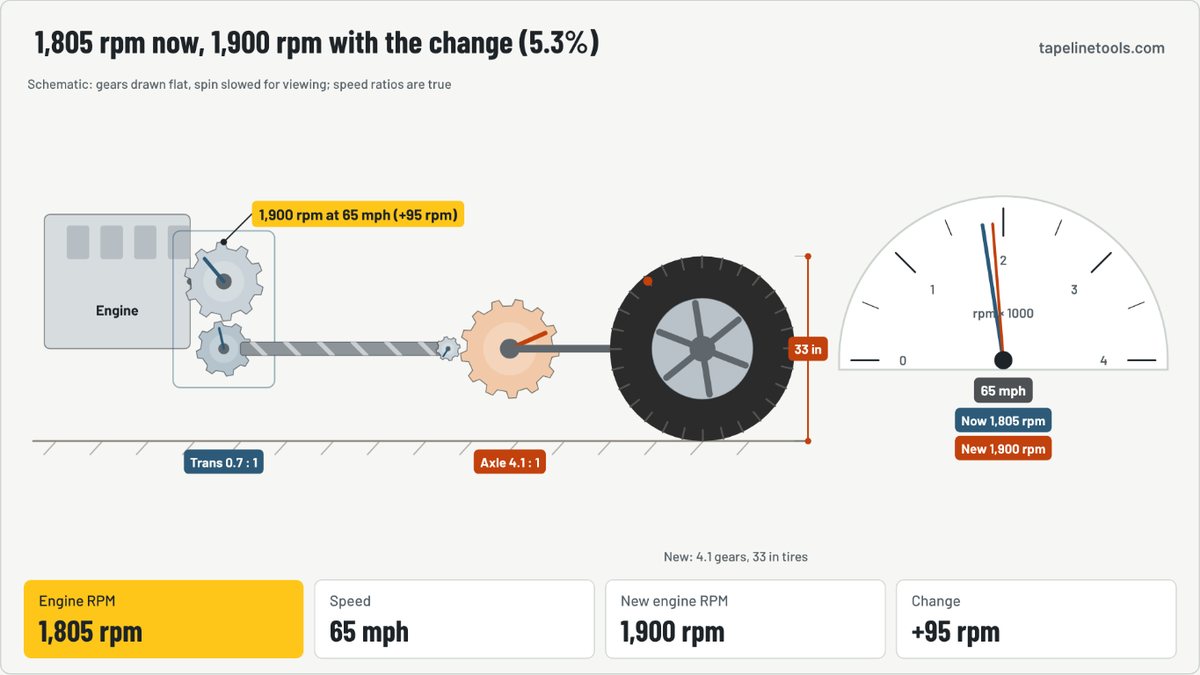
The animation and the step-by-step video above use your numbers. Here is the same walkthrough written out for the default example.
What you enter
- Axle (differential) ratio: 3.73 : 1. Printed on the axle tag or door-sticker axle code, e.g. 3.21, 3.55, 3.73, 4.10.
- Transmission gear ratio: 0.7 : 1. Top gear in most modern automatics and 6-speed manuals is an overdrive of about 0.60–0.85. Direct drive is 1.00; first gear is typically 3–4.7. Check your transmission spec sheet.
- Tire diameter: 31.6 in. Overall height of the tire. A 265/70R17 is about 31.6 in; use the tire size calculator for other sizes.
- Vehicle speed: 65 mph. Road speed in miles per hour (100 km/h = 62.1 mph).
- New axle ratio: 4.1 : 1. Enter the same ratio as above to compare a tire change only.
- New tire diameter: 33 in. Enter the same diameter as above to compare an axle change only.
What happens, step by step
- At 65 mph a 31.6 in tire turns 691 rpm.
- The 3.73 axle gears spin the driveshaft 3.73 times faster: 2,579 rpm.
- The 0.7 overdrive lets the engine turn slower: 1,805 rpm.
- Now 4.1 gears and 33 in tires at the same 65 mph.
- The engine turns 1,900 rpm, up 5.3%.
The answer: engine rpm at this speed is 1,805 rpm.
How it’s calculated
- Wheel RPM = mph × 336.13 ÷ tire diameter (in) (336.13 = 63,360 in per mile ÷ (60 min × π))
- Driveshaft RPM = wheel RPM × axle ratio
- Engine RPM = driveshaft RPM × transmission gear ratio ÷ (1 − slip)
- Combined: RPM = mph × axle × gear × 336.13 ÷ tire diameter
- Axle ratio to keep the same RPM on new tires = old axle ratio × new tire diameter ÷ old tire diameter
Worked example
A truck with 3.73 gears, a 0.70 overdrive and 31.6 in tires at 65 mph, comparing 4.10 gears with 33 in tires.
Inputs
- Axle (differential) ratio
- 3.73 : 1
- Transmission gear ratio
- 0.7 : 1
- Tire diameter
- 31.6 in
- Vehicle speed
- 65 mph
- Torque converter or clutch slip
- 0 %
- Compare a new axle ratio or tire size
- Yes
- New axle ratio
- 4.1 : 1
- New tire diameter
- 33 in
Results
- Engine RPM at this speed
- 1,805 rpm
- Driveshaft RPM
- 2,579 rpm
- Wheel RPM
- 691 rpm
- Overall (final drive) ratio
- 2.61 : 1
- Tire revolutions per mile
- 638
- New engine RPM
- 1,900 rpm
- RPM change
- 95 rpm
- RPM change (percent)
- 5.3%
- Axle ratio that keeps your current RPM with the new tires
- 3.9 : 1
Assumptions and limits
- Tire diameter is the nominal unloaded height. Under load a tire rolls slightly smaller, so real RPM is typically 1–3% higher.
- Slip is 0% unless you enter it. A locked torque converter or engaged manual clutch has essentially none.
- Transfer-case low range is not included. For 4-Lo, multiply the result by the low-range ratio (often 2.5–2.7).
Verify the result against the applicable local code, adopted code edition, manufacturer instructions and project requirements. See our methodology.
Questions
What RPM will I run at 70 mph?
With 3.73 gears, a 0.70 overdrive and 31.6 in tires: 70 × 3.73 × 0.70 × 336.13 ÷ 31.6 ≈ 1,944 rpm. The same truck with 3.21 gears turns about 1,673 rpm, and with 4.10 gears about 2,137 rpm.
What gear ratio do I need for bigger tires?
Multiply the old ratio by the new tire diameter ÷ old diameter. Going from 31.6 in to 33 in tires on 3.73 gears needs 3.73 × 33 ÷ 31.6 ≈ 3.90 to keep the same RPM, so 3.91 is the closest common ratio. 4.10 would gain a little extra pulling power.
Is a higher or lower axle ratio better for towing?
A numerically higher ratio (4.10 vs 3.55) multiplies torque more and usually carries a higher tow rating, at the cost of higher cruising RPM and fuel use. A lower ratio cruises quieter and more economically.
Where does the 336 in the RPM formula come from?
A mile is 63,360 inches. Dividing by 60 minutes per hour and by π (circumference = π × diameter) gives 336.13, which converts mph and tire diameter in inches straight to wheel RPM.