What the animation shows
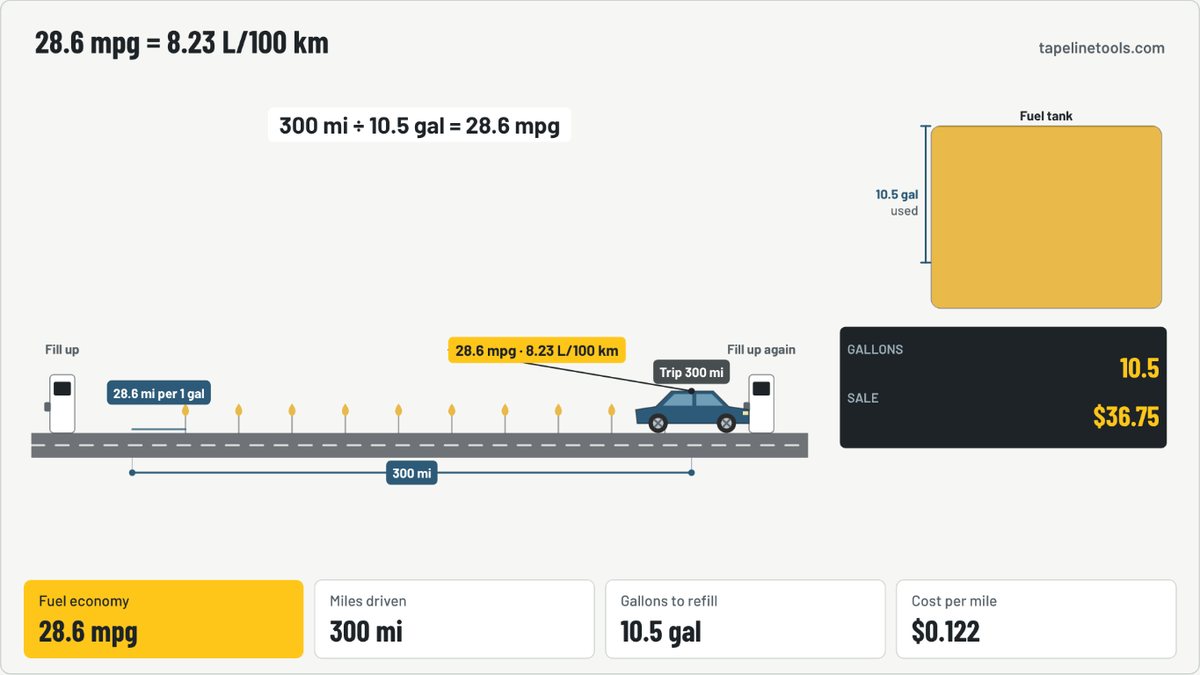
The animation and the step-by-step video above use your numbers. Here is the same walkthrough written out for the default example.
What you enter
- How you measured the distance: Trip meter miles.
- Miles driven (trip meter): 300 mi. Used when measuring by trip meter.
- Fuel to refill the tank: 10.5 gal. Gallons on the pump receipt when you filled back up to full. Fill to the first automatic click both times for consistency.
- Fuel price: 3.5 $/gal. Price per US gallon (per litre × 3.785). Enter 0 to skip costs.
- EPA rating to compare (optional): 0 mpg. Combined, city or highway figure from fueleconomy.gov or the window sticker. Leave 0 to skip.
What happens, step by step
- Start with a full tank and reset the trip meter.
- Each yellow drop is 1 gallon burned, every 28.6 miles.
- Fill back to the first click: 10.5 gallons is the fuel you used.
- 300 mi divided by 10.5 gallons is 28.6 mpg, $0.122 a mile.
The answer: fuel economy is 28.6 mpg.
How it’s calculated
- Miles driven = trip meter, or odometer now − odometer at the last fill-up
- MPG = miles driven ÷ gallons to refill
- L/100 km = 235.21 ÷ MPG (100 × 3.7854 L per gal ÷ 1.6093 km per mile)
- Cost per mile = fuel price ÷ MPG
- Versus EPA = (your MPG − EPA MPG) ÷ EPA MPG
Worked example
300 miles on the trip meter, 10.5 gallons to refill at $3.50 a gallon, compared with a 32 mpg EPA combined rating.
Inputs
- How you measured the distance
- Trip meter miles
- Miles driven (trip meter)
- 300 mi
- Odometer at first fill-up
- 45210 mi
- Odometer at this fill-up
- 45510 mi
- Fuel to refill the tank
- 10.5 gal
- Fuel price
- 3.5 $/gal
- EPA rating to compare (optional)
- 32 mpg
Results
- Fuel economy
- 28.6 mpg
- Fuel consumption
- 8.23 L/100 km
- Kilometres per litre
- 12.15 km/L
- Fuel cost per mile
- 0.123 $/mi
- Fuel cost for this distance
- $36.75
- Distance driven
- 300 mi
- Compared with the EPA rating
- -10.7%
Assumptions and limits
- The tank was filled to the same level (first automatic click) at both fill-ups, so the gallons added equal the fuel burned.
- US gallons (3.785 L). For UK imperial mpg multiply the result by 1.201.
- Average over several tanks for a reliable figure; one tank can be off by 5% or more from pump shut-off variation.
Verify the result against the applicable local code, adopted code edition, manufacturer instructions and project requirements. See our methodology.
Questions
How do I calculate my gas mileage?
Fill up, reset the trip meter, drive, and fill up again. Divide the miles by the gallons from the second fill-up: 300 miles ÷ 10.5 gallons = 28.6 mpg.
How do I convert mpg to L/100 km?
Divide 235.21 by the mpg. 30 mpg is 7.84 L/100 km and 20 mpg is 11.76 L/100 km. The same formula converts back: 235.21 ÷ L/100 km = mpg.
Why is my real mpg lower than the EPA rating?
EPA ratings come from standardized lab cycles. Short trips, cold weather, highway speeds above 65 mph, towing, roof boxes and low tire pressure commonly cut real mpg by 10–25%.
Is the dashboard mpg readout accurate?
It is an estimate from injector timing and is usually 2–5% optimistic. The fill-up method measures the fuel you actually bought.