What the animation shows
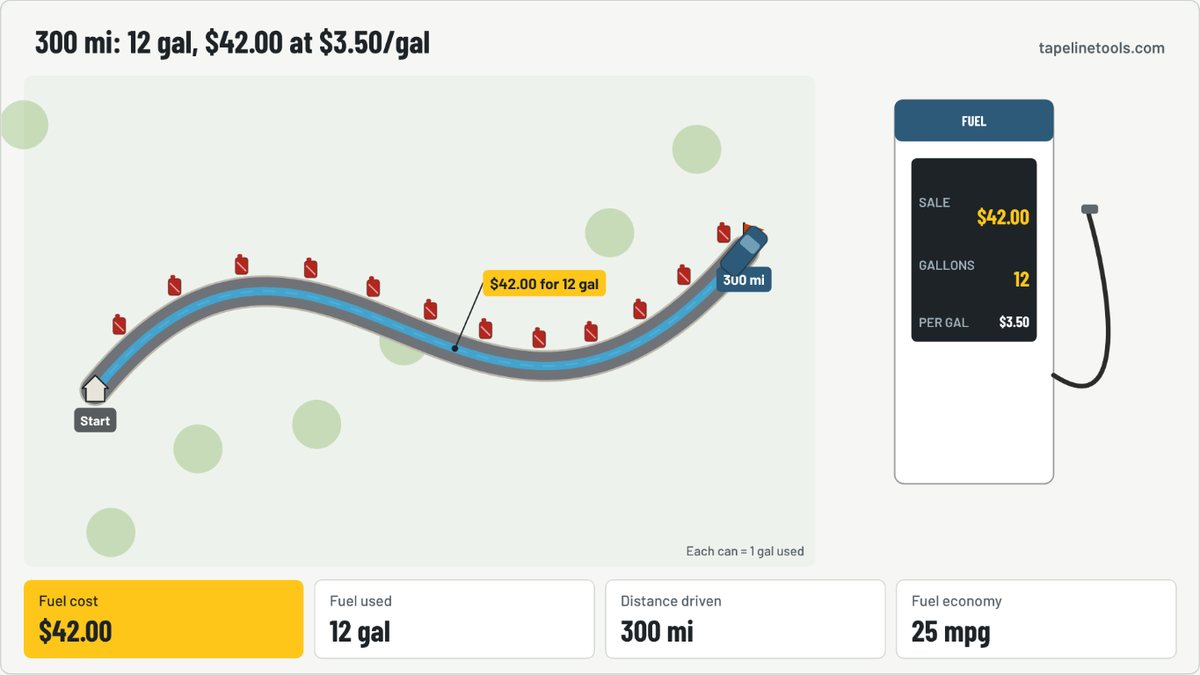
The animation and the step-by-step video above use your numbers. Here is the same walkthrough written out for the default example.
What you enter
- Trip distance (one way): 300 mi.
- Round trip: No.
- Normal fuel economy: 25 mpg.
- Fuel economy reduction while towing: 0 %.
- Fuel price: 3.5 $/gal.
What happens, step by step
- The car drives 300 mi at 25 mpg, burning fuel as it goes.
- Each red can left on the road is 1 gallon burned.
- The pump counts gallons and dollars as the miles add up.
- 300 mi at 25 mpg is 12 gal, times $3.50 a gallon.
The answer: fuel cost is $42.00.
How it’s calculated
- Effective MPG = MPG × (1 − towing reduction)
- Gallons = miles ÷ effective MPG
- Cost = gallons × price
Worked example
300 miles one way at 25 mpg and $3.50/gal.
Inputs
- Trip distance (one way)
- 300 mi
- Round trip
- No
- Normal fuel economy
- 25 mpg
- Fuel economy reduction while towing
- 0 %
- Fuel price
- 3.5 $/gal
Results
- Fuel cost
- $42.00
- Fuel needed
- 12 gal
- Fuel economy used
- 25 mpg
- Total distance
- 300 mi
Assumptions and limits
- Average fuel economy over the whole trip. Terrain, wind and speed change real consumption.
Verify the result against the applicable local code, adopted code edition, manufacturer instructions and project requirements. See our methodology.
Questions
How much does towing reduce MPG?
Commonly 20–50% depending on trailer weight, frontal area and speed. Travel trailers with large fronts are at the high end.
How do I calculate gas for a trip?
Divide the miles by your MPG to get gallons, then multiply by the fuel price.