What the animation shows
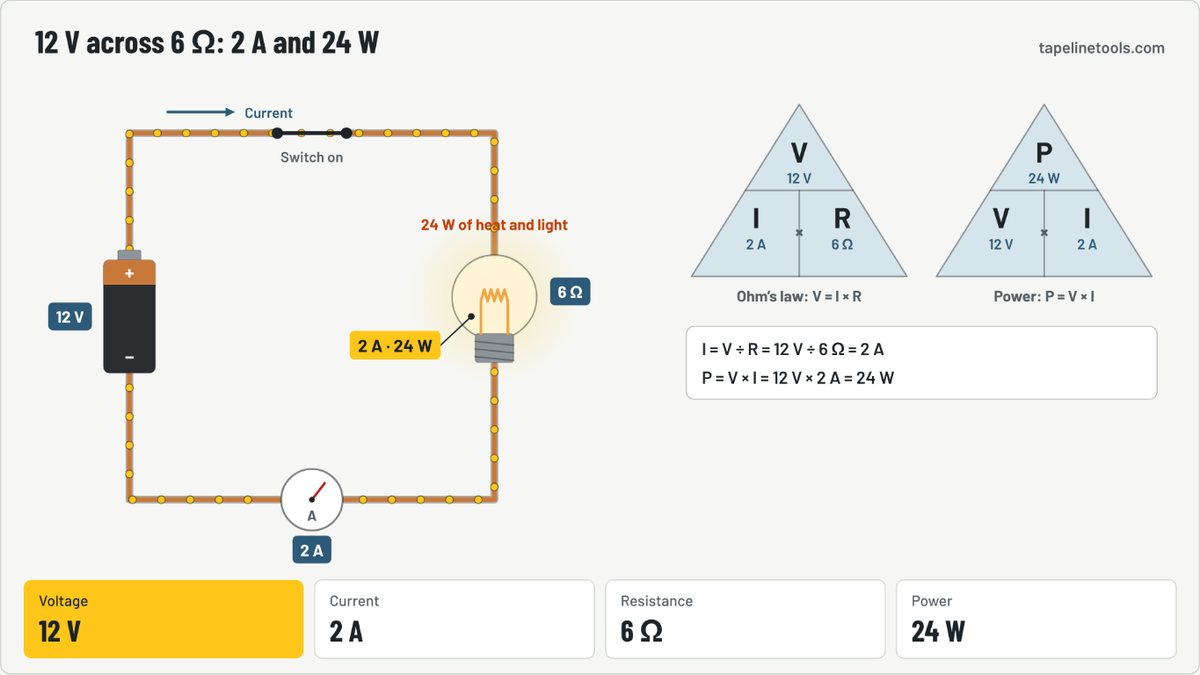
The animation and the step-by-step video above use your numbers. Here is the same walkthrough written out for the default example.
What you enter
- Values you know: Voltage and resistance. Only the two values named here are used; the other two are calculated.
- Voltage: 12 V.
- Resistance: 6 Ω. For a heating element, resistance = volts² ÷ rated watts (a 1,500 W heater at 120 V is 9.6 Ω).
What happens, step by step
- Close the switch and current flows out of the plus terminal.
- I = V ÷ R: the current is 2 A.
- More current means the dots move faster around the loop.
- P = V × I: the power is 24 W.
- The filament turns 24 W into heat and light.
The answer: current is 2 A.
How it’s calculated
- Ohm’s law: voltage V = current I × resistance R
- Power: P = V × I
- Combining the two: P = I² × R = V² ÷ R
- From any two known values, rearrange: I = V ÷ R, R = V ÷ I, I = P ÷ V, V = √(P × R), I = √(P ÷ R)
Worked example
A 12 V battery across a 6 Ω resistor.
Inputs
- Values you know
- Voltage and resistance
- Voltage
- 12 V
- Current
- 2 A
- Resistance
- 6 Ω
- Power
- 24 W
Results
- Current
- 2 A
- Voltage
- 12 V
- Resistance
- 6 Ω
- Power
- 24 W
Assumptions and limits
- DC circuit, or an AC circuit with a purely resistive load (power factor 1). Motors, LED drivers and transformers need power factor and impedance, not plain resistance.
- Resistance is taken as constant. Real heating elements and lamp filaments have a lower resistance when cold than at operating temperature.
Verify the result against the applicable local code, adopted code edition, manufacturer instructions and project requirements. See our methodology.
Questions
How many ohms is a 1500 watt heater?
At 120 V, R = V² ÷ P = 14,400 ÷ 1,500 = 9.6 Ω, and it draws 1,500 ÷ 120 = 12.5 A. At 240 V a 1,500 W element is 38.4 Ω.
How do you calculate amps from volts and ohms?
Divide volts by ohms: I = V ÷ R. A 12 V source across 6 Ω pushes 2 A, and the resistor dissipates 12 × 2 = 24 W.
What size resistor do I need for an LED?
R = (supply volts − LED forward volts) ÷ LED current. For a 12 V supply, a 2 V red LED at 20 mA: (12 − 2) ÷ 0.02 = 500 Ω (use the next standard value, 510 Ω), dissipating 0.2 W, so a 1/2 W resistor.
Does Ohm’s law work for AC?
Yes for resistive loads like heaters and incandescent bulbs, using RMS volts and amps. For motors and electronics, current also depends on reactance and power factor.