What the animation shows
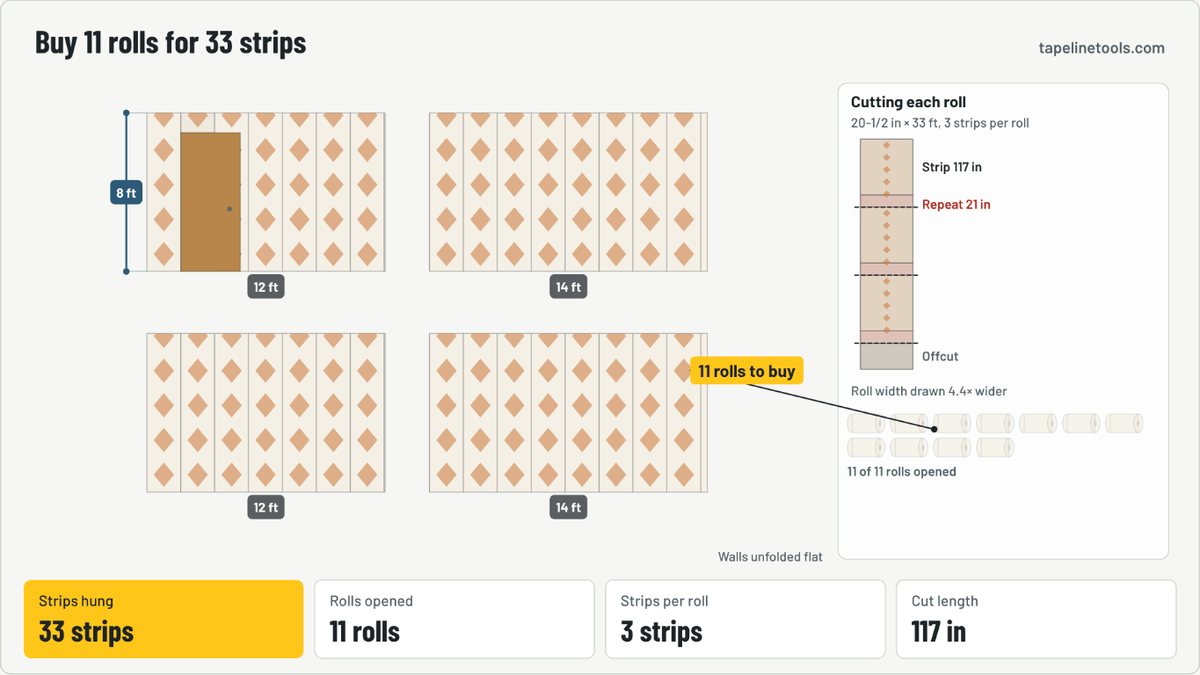
The animation and the step-by-step video above use your numbers. Here is the same walkthrough written out for the default example.
What you enter
- Walls: 4 walls.
- Wall height (to be papered): 8 ft.
- Doors: 1. Each door saves the full-height strips it covers. Windows are not deducted: the pieces above and below still use a pattern-matched strip.
- Pattern repeat: 21 in. Printed on the label, e.g. "21 in repeat". Enter 0 for random-match papers.
- Roll size: US double roll, 20.5 in × 33 ft (56 sq ft). US papers are often priced per single roll but sold in double-roll bolts. Check the label for width and length.
What happens, step by step
- Each strip is wall height plus one pattern repeat: 117 in.
- Every wall takes its width ÷ 20-1/2 in, rounded up, in strips.
- A 33 ft roll gives 3 strips; 33 strips need 11 rolls.
The answer: rolls to buy is 11 rolls.
How it’s calculated
- Cut length = wall height + pattern repeat (or + trim allowance if larger)
- Strips per roll = roll length ÷ cut length, rounded down
- Strips per wall = wall width ÷ roll width, rounded up; add up all walls
- Subtract for each door: 3 ft ÷ roll width, rounded down
- Rolls = strips ÷ strips per roll, rounded up
Worked example
A 12 × 14 ft room, 8 ft walls, one door, 21 in repeat, US double rolls (20.5 in × 33 ft).
Inputs
- Walls
- 12; 14; 12; 14 ft
- Wall height (to be papered)
- 8 ft
- Doors
- 1
- Pattern repeat
- 21 in
- Roll size
- US double roll, 20.5 in × 33 ft (56 sq ft)
- Custom roll width
- 20.5 in
- Custom roll length
- 33 ft
- Trim allowance (no repeat)
- 4 in
- Price per roll
- 0 $
Results
- Rolls to buy
- 11 rolls
- Strips to hang
- 33 strips
- Strips per roll
- 3 strips
- Cut length per strip
- 117 in
- Wall area to paper
- 395 sq ft
- Coverage per roll
- 56.4 sq ft
- Paper bought beyond wall area
- 57%
Assumptions and limits
- Each wall starts a new strip at its corner, which is how paper is hung.
- One full pattern repeat is allowed per strip to line the pattern up; straight and drop matches are treated the same.
- Doors are 3 × 7 ft; the short piece above a door is cut from roll offcuts.
- Windows are not deducted because the pieces above and below need a matched strip.
Verify the result against the applicable local code, adopted code edition, manufacturer instructions and project requirements. See our methodology.
Questions
How many rolls of wallpaper for a 12 × 14 room?
With 8 ft walls, one door and a 21 in repeat on 20.5 in × 33 ft double rolls: 34 strips around the room, minus 1 for the door, at 3 strips per roll is 11 double rolls.
How does pattern repeat change the count?
Each strip has to start at the same point in the pattern, so up to one repeat is cut off per strip. An 8 ft wall with a 21 in repeat uses 117 in per strip, and a 33 ft roll then gives 3 strips instead of 4.
What is the difference between a single and a double roll?
In the US, wallpaper is usually priced per single roll (about 28 sq ft) but packed as double rolls (about 56 sq ft, 20.5 in × 33 ft). A Euro roll, 0.53 × 10.05 m, is close to a US double roll.
Should I buy an extra roll?
Usually yes. A spare from the same batch is the only way to repair damage later with an exact color match.