What the animation shows
The animation and the step-by-step video above use your numbers. Here is the same walkthrough written out for the default example.
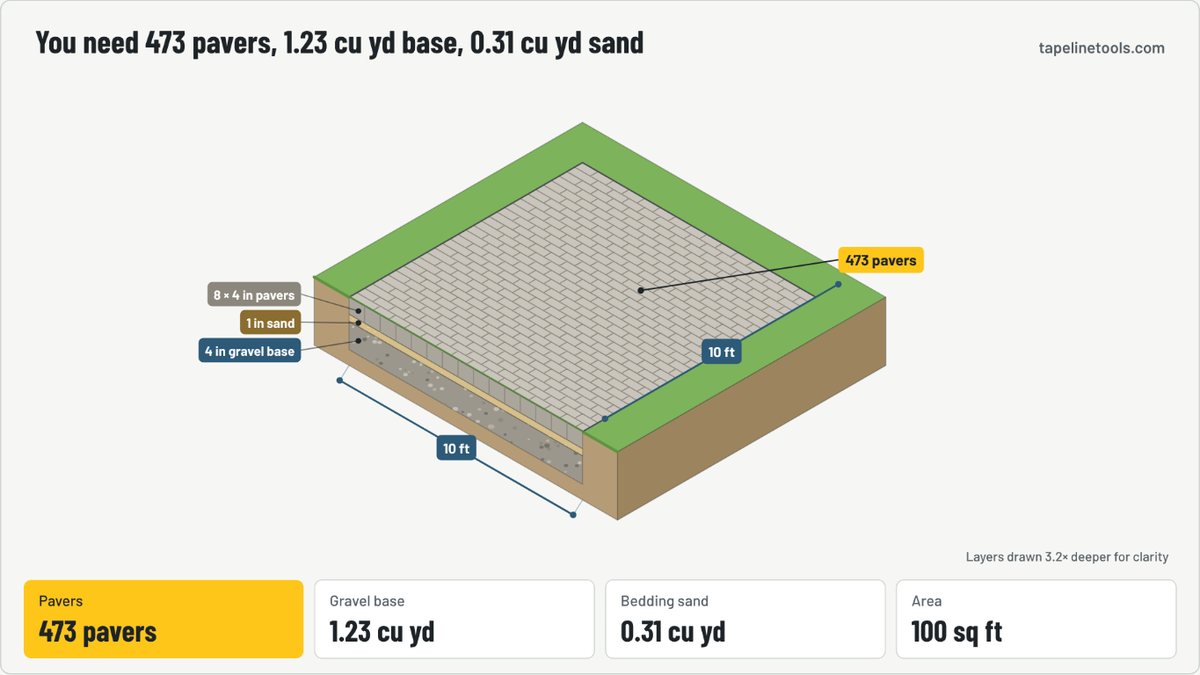
What you enter
- Areas: 10 × 10 ft.
- Paver length: 8 in.
- Paver width: 4 in.
- Joint width: 0 in.
- Waste for cuts: 5 %.
- Gravel base depth: 4 in. Patios commonly 4–6 in; driveways 8–12 in.
- Bedding sand depth: 1 in.
What happens, step by step
- Gravel goes in first for drainage: area times depth is 1.23 cu yd.
- Bedding sand on top is screeded to an even 1 in.
- At 8 × 4 in, it takes 4.5 pavers per square foot.
- 100 sq ft ÷ paver size, plus 5% for cuts, is 473 pavers.
The answer: pavers is 473 pavers.
How it’s calculated
- Pavers = area ÷ ((length + joint) × (width + joint)) × (1 + waste %)
- Base and sand = area × depth
Worked example
100 sq ft patio with 4 × 8 in pavers, 5% waste, 4 in base, 1 in sand.
Inputs
- Areas
- 10 × 10 ft
- Paver length
- 8 in
- Paver width
- 4 in
- Joint width
- 0 in
- Waste for cuts
- 5 %
- Gravel base depth
- 4 in
- Bedding sand depth
- 1 in
Results
- Pavers
- 473 pavers
- Gravel base
- 1.23 cu yd
- Bedding sand
- 0.31 cu yd
- Area
- 100 sq ft
Assumptions and limits
- Base volume is before compaction; order 10–20% more for compacted base.
- Edge restraints and polymeric sand are not included.
Verify the result against the applicable local code, adopted code edition, manufacturer instructions and project requirements. See our methodology.
Questions
How many 4×8 pavers per square foot?
4.5 pavers per square foot (144 ÷ 32).
How much base do I need under pavers?
About 4–6 in of compacted gravel base for foot traffic, 8–12 in for driveways, more on clay soils.