What the animation shows
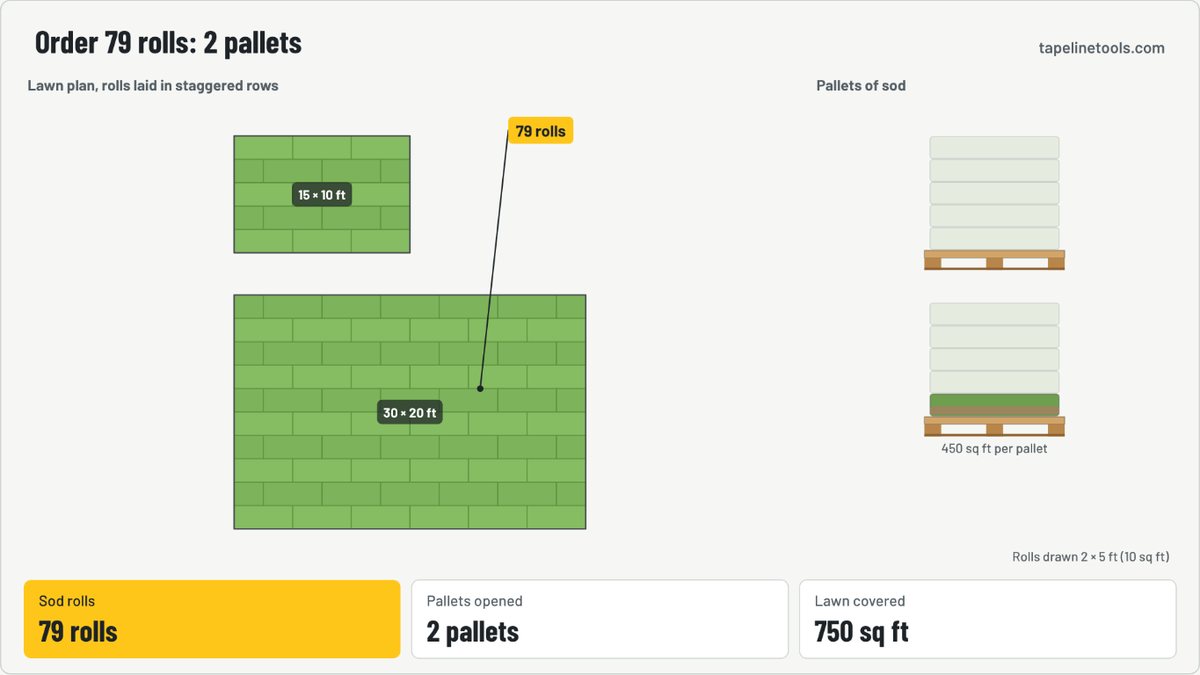
The animation and the step-by-step video above use your numbers. Here is the same walkthrough written out for the default example.
What you enter
- Lawn areas: 30 × 20; 15 × 10 ft.
- Coverage per sod roll or piece: 10 sq ft. Common US sizes: 2 × 5 ft rolls (10 sq ft) and 16 × 24 in slabs (2.67 sq ft). Big rolls cover far more. Ask your sod farm.
- Coverage per pallet: 450 sq ft. Pallets typically hold 400–500 sq ft, depending on the farm and grass type.
- Extra for cuts and edges: 5 %. About 5% for rectangles; 10% or more for curves, beds and many edges.
- Also calculate grass seed: No. Shows how much seed would cover the same lawn area.
- Seeding rate: 7 lb per 1,000 sq ft. Use the rate on the seed label. New-lawn rates are roughly 2–3 lb for Kentucky bluegrass and 6–8 lb for tall fescue per 1,000 sq ft; overseeding uses about half. 7 lb/1,000 sq ft ≈ 34 g/m².
What happens, step by step
- Rolls go down in straight rows, joints staggered like brickwork.
- Each roll covers 10 sq ft; edge pieces are cut to fit.
- A pallet holds 450 sq ft, about 45 rolls.
- 750 sq ft plus 5% waste is 79 rolls, 2 pallets.
The answer: sod rolls or pieces is 79 rolls.
How it’s calculated
- Lawn area = Σ length × width of each area
- Sod to order = lawn area × (1 + waste %)
- Rolls = sod to order ÷ coverage per roll, rounded up
- Pallets = sod to order ÷ coverage per pallet, rounded up (or full pallets plus loose rolls for the remainder)
- Grass seed (lb) = lawn area ÷ 1,000 × seeding rate (lb per 1,000 sq ft)
Worked example
Two lawn areas, 30 × 20 ft and 15 × 10 ft, with 10 sq ft rolls, 450 sq ft pallets and 5% waste.
Inputs
- Lawn areas
- 30 × 20; 15 × 10 ft
- Coverage per sod roll or piece
- 10 sq ft
- Coverage per pallet
- 450 sq ft
- Extra for cuts and edges
- 5 %
- Sod price per square foot
- 0 $/sq ft
- Also calculate grass seed
- Yes
- Seeding rate
- 7 lb per 1,000 sq ft
Results
- Sod rolls or pieces
- 79 rolls
- Pallets (rounded up)
- 2 pallets
- Or full pallets
- 1 pallet
- … plus loose rolls
- 34 rolls
- Lawn area
- 750 sq ft
- Sod to order (with waste)
- 788 sq ft
- Grass seed
- 5.3 lb
Assumptions and limits
- Each area is a rectangle; split L-shapes into rectangles and approximate curves.
- Cost is rolls × roll coverage × price per square foot.
- Seed is calculated on the lawn area without waste, at the label rate you enter.
Verify the result against the applicable local code, adopted code edition, manufacturer instructions and project requirements. See our methodology.
Questions
How much does a pallet of sod cover?
Most pallets cover 400–500 sq ft, with 450 sq ft the most common. That is 45 rolls of 2 × 5 ft or about 170 slabs of 16 × 24 in.
How many rolls of sod do I need for 1,000 sq ft?
With 10 sq ft rolls, 1,000 sq ft takes 100 rolls, or 105 with 5% extra for cuts — a little over two 450 sq ft pallets.
How much grass seed do I need per 1,000 sq ft?
It depends on the species: about 2–3 lb of Kentucky bluegrass or 6–8 lb of tall fescue for a new lawn. Overseeding an existing lawn uses roughly half the new-lawn rate. Always follow the bag label.